A Mouth Full of Future
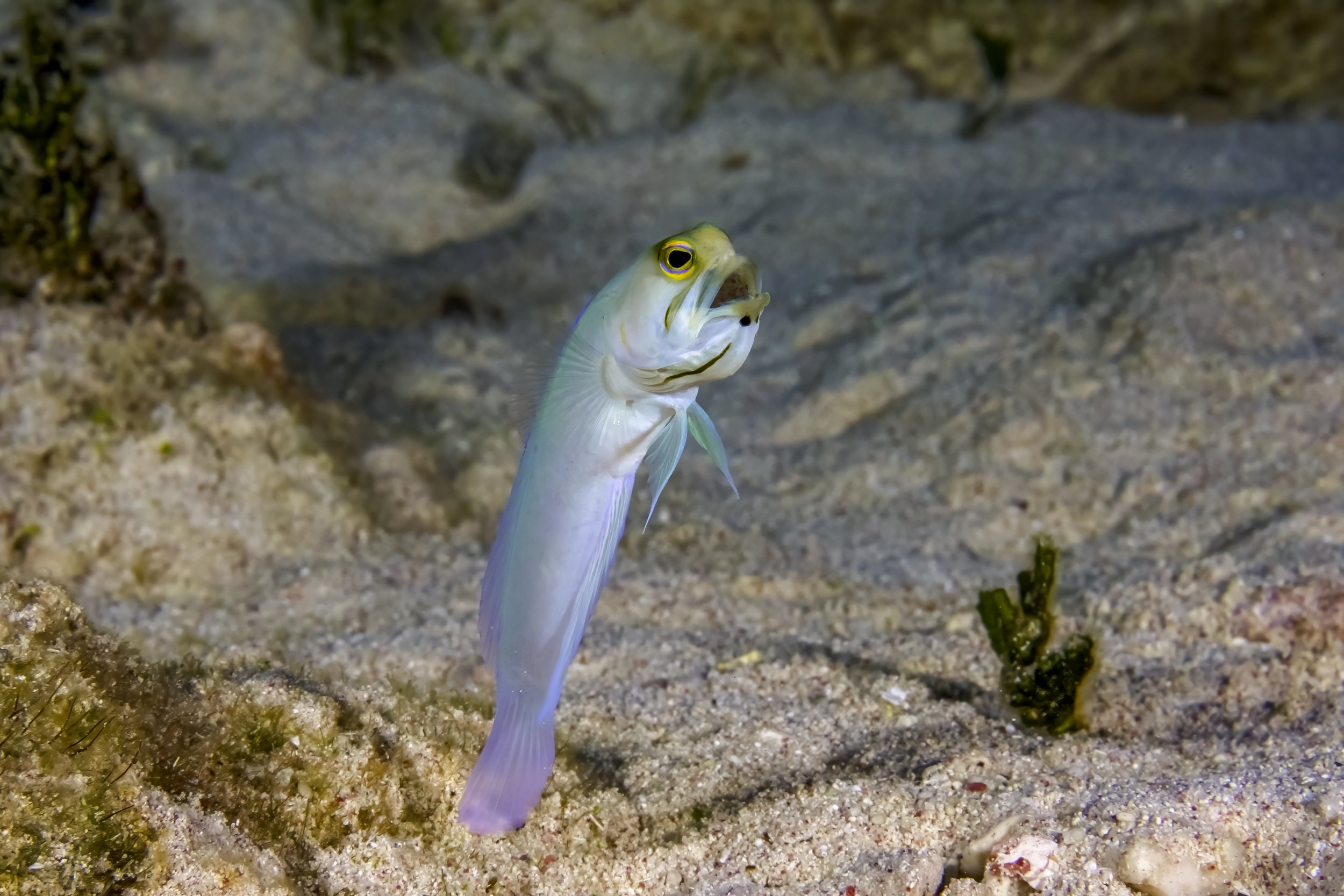
A yellowhead jawfish does not look like it is running a major operation.
At first glance, it looks like a small fish in a hole.
A very alert small fish in a hole, but still. Half a body. Big eyes. Yellow head. Mouth slightly open. Usually wearing the expression of someone who has seen enough divers for one morning.
But that little hole in the sand is not random.
It is home, shelter, lookout post, nursery, and construction project. It is a tiny piece of ocean real estate, built and maintained one mouthful at a time.
That is the part I love.
The Sit-and-Wait Department
Yellowhead jawfish belong squarely in the sit-and-wait department.
This is not a subject you force. It is a subject you earn slowly, by giving it space, staying still, and letting the behavior come back on its own.
To photograph a jawfish properly, you settle into the sand and wait.
Sometimes that means spending most of a dive in one spot, working with one fish in one hole, firing off hundreds of frames to come away with one image that actually feels right.
That may sound excessive.
It is not.
With a subject like this, tiny changes matter. The height of the fish above the burrow. The angle of the head. The eyes. The mouth. The way it holds position. The moment it relaxes enough to show a little more of itself.
You are not waiting for the ocean to perform.
You are waiting for the fish to trust the moment.
Or at least settle enough to let you make a decent frame.
The Male Has a Job
The story gets even better when reproduction enters the picture.
With yellowhead jawfish, the male carries the egg mass in his mouth while the eggs develop.
That is not a small commitment.
For a period of time, his mouth is not just a mouth. It is an incubator. A nursery. A protective chamber. A place where the next generation is held and guarded before it is released into the water.
So when you see a male jawfish with a swollen mouth, he may not be eating.
He may be carrying eggs.
That changes everything about the encounter.
He is not just sitting there.
He is working.
He is protecting the burrow. Watching for danger. Managing his little patch of sand. Carrying a mouth full of future while still looking slightly annoyed that anyone noticed.
Respect.
A Small Science Note
For the record, the yellowhead jawfish is Opistognathus aurifrons. It is a small burrow-dwelling reef fish found on sand and rubble bottoms.
Behavior in One Small Hole
This image is why jawfish are such rewarding subjects.
It is not a big scene. It is not dramatic in the usual underwater photography sense. It is one small fish, one burrow, one patch of sand, and a moment of behavior most divers would probably swim right past.
But if you stop and watch, there is a lot happening.
This male is holding fertilized eggs in his mouth. What might look at first like a simple fish portrait is actually a moment of parental care, one of the more remarkable behaviors on the reef.
He is staying close to the burrow, alert and watchful, managing his small patch of sand while carrying the next generation with him.
That is what makes this kind of subject so interesting. There is so much life and responsibility wrapped into one little fish in one little hole.
The photograph becomes more than a portrait.
It becomes a story.
Going Back Matters
This is where going back to the same dive sites week after week paid off.
One dive gives you a glimpse.
Repeated dives let you understand a place.
Not in some overly romantic way. The fish did not know my name. We were not pen pals. But I knew where certain jawfish lived. I knew which sand patches held burrows. I knew which fish would rise a little higher if I stayed calm, and which ones would vanish the second I got too close.
That kind of knowledge does not come from rushing through a site once.
It comes from returning.
Week after week, you begin to learn the small geography of a reef. The sand patch where the jawfish lives. The coral head with the blenny. The sponge with the shrimp. The little area that looks empty until you stop moving and let it become alive.
That is one of the gifts of working underwater.
Not just visiting once, but returning enough to notice change.
A jawfish that was only a yellow head in a hole one week might be a male holding eggs the next. Suddenly the same subject becomes a different story.
Same fish.
Different moment.
And if you are lucky enough to be there, and patient enough not to ruin it, you get to witness something most people will never see.
The Right Tool for the Moment
This is also where equipment matters, but only because the behavior matters first.
For this kind of work, I liked a 60mm macro lens behind a flat port.
Not too long. Not too wide.
Long enough to see the details, short enough to work close, and close enough for the strobes to do what strobes do underwater.
Quick-cycling strobes matter too. Two of them.
You are not just blasting away randomly, but you also cannot be waiting on slow gear while the fish gives you half a second of something interesting.
A mouth opens.
The eggs show.
The eyes turn.
Then the moment is gone.
The strobes are not there to make the fish look fake. They are there to bring back the color, texture, and detail that water takes away. The yellow head, the pale body, the eggs, the sand, the edges of the burrow, all of that depends on clean light and being close enough for that light to work.
The rest is patience.
Wait. Watch. Shoot. Adjust. Wait again.
That is the rhythm.
Small Does Not Mean Simple
The longer I spent underwater, the more I learned that small does not mean simple.
People see a hole.
They miss the home.
They see a fish.
They miss the behavior.
They see something small.
They miss the whole life happening in front of them.
A yellowhead jawfish asks you to slow down. It asks you to stay still. It asks you to notice the difference between a fish hiding and a fish guarding something precious.
This is why I love the small stuff.
Because when you stop chasing the big thing and settle into one patch of sand, the reef gets larger.
A fish in a hole becomes a builder.
A mouth becomes a nursery.
A quiet moment becomes something you remember years later.
And if you are lucky, you come back with one usable photograph from a few hundred frames.
Worth it.
Beauty Below Notes
Beauty Below is built from years spent underwater, but these stories are not here to make the ocean seem more interesting than it already is. It does not need the help. They are here to share what was seen, what was learned, and why it still matters to look carefully.
